What Is Lineboring? A Plain-English Guide for Maintenance Crews
Oct 26, 2026
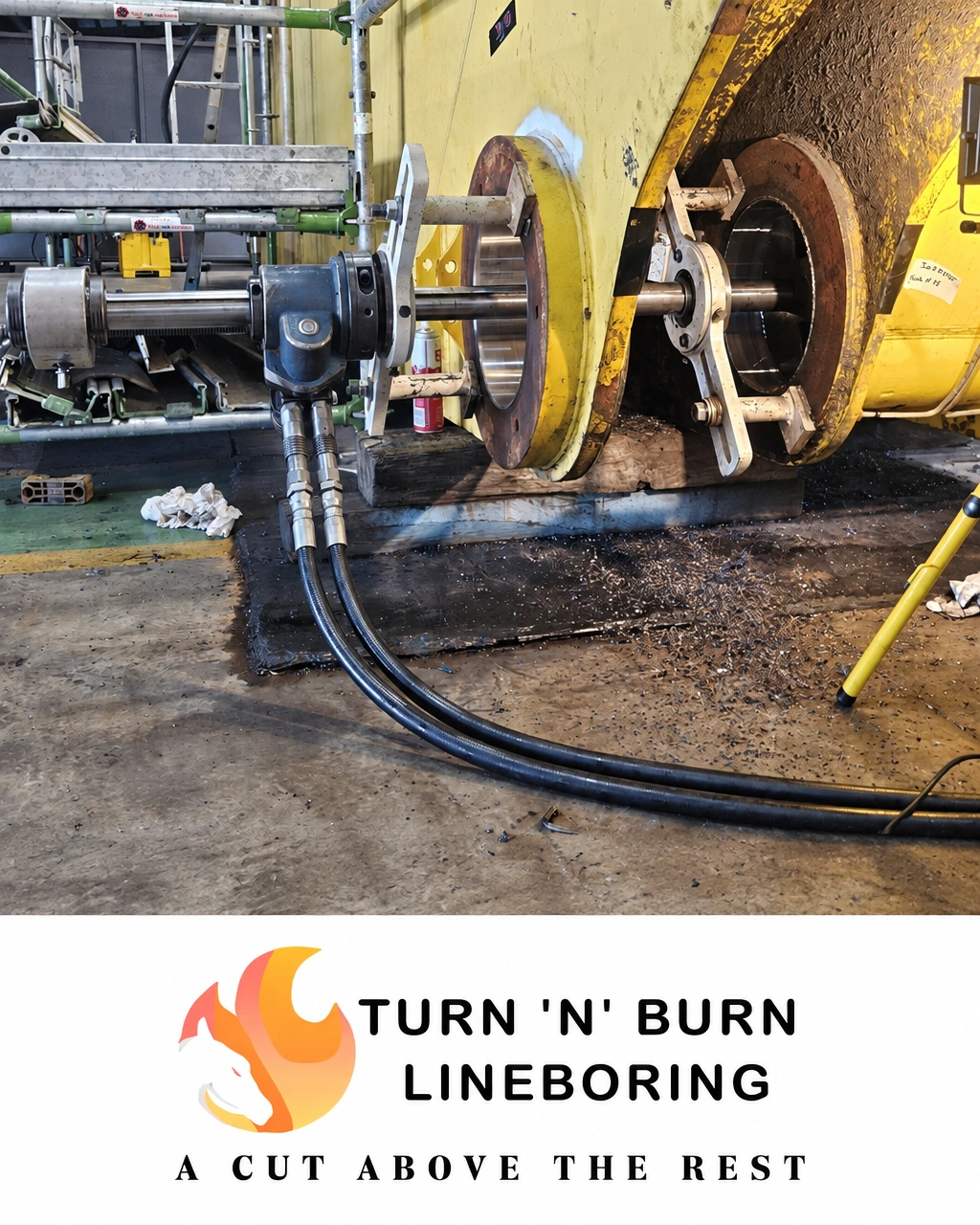
Lineboring is machining a bore back to a true circle and a true centreline while the component stays on the machine. No removal, no transport, no workshop queue.
That is the whole idea. The rest is setup, cutting, welding and measuring.
What is actually being fixed
A pin joint wears in a predictable way. The bore goes oval as the pin loads it in one direction, tapers along its length, bell-mouths at the ends, and scores once grit gets in. The pin wears too, and the bush — if there is one — takes the worst of it.
By the time the movement is obvious, the bore is no longer round or straight, and a new pin in a worn bore will not last. Lineboring cuts the bore back to a circle and a centreline so the joint can go back together at the right clearance.
How the cut is made
A boring bar is set up through the bore and aligned to the original centreline of the joint. Where possible it is referenced off the undamaged bore on the other side, rather than off the worn one. A drive unit turns the bar, a cutting tool is fed through the bore, and the worn, oval, tapered or scored metal comes out — leaving a clean, round, straight hole ready to be welded.
Then one of two things follows:
Bore welding, to put metal back into the bore so it can be machined to OEM diameter; or
a oversize bush or bearing, fitted to the machined bore, using liquid nitrogen shrink fitting where the interference calls for it.
Most worn bore repairs use some combination of the three: machine it out, weld it back, fit new.
The size range
Mobile lineboring capacity runs from 38mm to 900mm. That covers:
small linkage and hinge pin bores at the bottom of the range;
loader arm, stick, boom and bucket bores through the middle;
large dipper, bucket and crusher bores and draglines at the top.
If a bore is outside that range, say so in the enquiry rather than finding out on site.
Where lineboring gets used
Excavators: bucket, stick and boom pin bores, bucket linkage, cylinder eyes.
Loaders and dozers: loader arms, tilt and lift linkages, blade and push-arm bores, ripper assemblies.
Mining plant: shovel and dragline components, crusher and chute bores, conveyor structure pins.
Civil and ag equipment: grader and scraper linkages, implement mounts, hinge points.
Workshop jobs: anything too large or difficult to set up in the machine shop.
Mining, engineering, civil construction, agriculture, marine and diesel fitting all end up in the same place: a worn bore and a machine that is stopped.
Why on-site matters more than the machining
Hauling a stick, a bucket or a loader arm to a workshop means removal, transport in both directions, a place in a queue, and reinstallation. The machining might take a day. The transport and the queue are what stops production.
Mobile lineboring removes that part of the job. A mine-site-compliant truck and a fully equipped mobile trailer — Climax boring equipment, Miller welders, a 40KVA generator — set up at the machine. The component stays on the machine, on its own tracks. The same setup handles the workshop side when a component is small enough to bring in.
Based in Calliope, mobile 24/7 across all of Queensland and surrounding locations. Urgent breakdowns and downtime-sensitive work get answered first.
What to send with the enquiry
bore diameter, measured where possible;
the machine and the component;
whether the pin and bush are still fitted;
site location and access, including whether the machine can be moved;
how urgent it is — whether the machine is down now or the job is planned.
Send bore size, machine or component, site location and how urgent the job is, and the job can be scoped from there.